Falmouth Anchor Column: Nature’s Guardians

My latest nature column as printed in the Falmouth Anchor, Exeter/Falmouth university’s student newspaper.

Whose countryside is it anyway? It’s the ultimate question and has been batted around much of the media recently between two ‘sides’ – the conservation community and the shooting/landowning fraternity – with the attitude we hold towards wildlife and nature as a whole at its core.

Perhaps the most notable incident involved the star of Springwatch, Chris Packham. He provoked the Countryside Alliance to demand the BBC sack him due to him calling on conservation NGOs to increase campaigning pressure against badger culling, fox hunting and illegal hen harrier persecution on grouse moors. This in turn led another columnist, Robin Page, of the Telegraph, to accuse Chris Packham of “knowing nothing” of the countryside.

I wonder how many students at this university have been similarly accused, simply because they love wildlife but don’t necessarily want to shoot  it. As someone born and raised in a landscape of woodland and farmland, who has devoted their studying to conserving wildlife in the field, I find this a highly offensive view. I’m not overly sentimental about nature; I understand the need for culling where necessary, and that wildlife is very much red in tooth and claw.

But, nature needs space too, and that is the point which many fail to recognise: their countryside is an industrial landscape as man-made as the towns they claim to despise. Many also state they are ‘real’ conservationists, yet this generally only seems to be of species that can survive in the conditions that intensive farming creates, and if it can, then make absolutely no impact on their activities.

Cooperation is necessary if we are to improve the future of the UK’s nature. But as long as these attitudes still stand, in many of those who manage a lot of the land where it could best flourish, it will be difficult.
Nature Diary (& Poetry Corner): A Cornish Wood, 21st November

The change from the lukewarm cosiness of Autumn to the first days of ‘Christ it’s cold’ statements upon the fall of Winter are well

alanlee

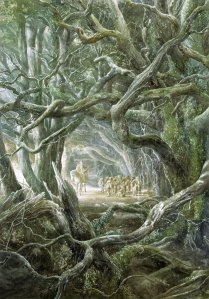
Mirkwood from ‘The Hobbit’, as depicted by Alan Lee.

documented, and this blog has been no exception.

Cornwall gets to linger in slightly milder climes than the rest of the country for longer, but those icy winds can only be bayed for so long. A quick trip to see the spoonbills and massive wigeon flock at Hayle estuary today (successful on both counts – with a goosander appearance for bonus points) was slightly overwhelmed by blasts of Atlantic gale Jack Frost seemed to have left his signature upon.

Driving down to my ‘secret’ wood near Gweek, the hedgerow-guarded country lanes bore dwarfed and gnarled oaks now stripped to skeletal form. Rather than dead leaves, it was a flock of several dozen fieldfares that scattered from their branches in the wind – one of the few songbirds that only comes here in cooler times to the live out the season of not-so-plenty.

Setting up my camera trap at a busy badger latrine, I was suddenly struck by how quickly the woods had changed character to it’s winter self. Bloody hell, it barely felt like a month had past since I was admiring the blooms of bluebells and wild garlic.

And so the wait begins.

Snag and crack! How Winters chill grasps the hazel roots,
And through the oak leaf, ivy and bramble, they tangle round my boots.
But while it may hide sweet scents and shades, to dance upon a distant Spring’s breath,
It is now under the grey sky, coppice brown and bloated stream,
The wood becomes a living death.

One of the most depressing things about conservation? How Middle-class it all is.

This past weekend saw me attending my third New Networks for Nature event in Stamford – essentially, a ‘relaxed’ conference that’s celebrates both the scientific and cultural aspects of nature in one.

I owe a lot to New Networks, especially given my first one back in 2012 was what launched me into youth network A Focus on Nature for the first time, which I am currently proud to sit on the committee for. But this year, I didn’t come away with the same ‘ooh, that was absolutely fab’ feeling as before. Don’t get me wrong, there were many great points, but others not so much I won’t bother rambling about them here though – bar one.

In the space of one coffee break, three people I’d never spoken to before all happened to approach me, and, as if they were fates sent to dictate the idea of my next blog, each said (more or less) “this is all brilliant, but you can’t help noticing how white and middle-class it all is, can you?”

“Well,” I’d reply, “you could pretty much say the same for the entirety of the conservation movement in the UK.” Continue reading