The Devon Beavers: Brave New World?

Copyright David Plummer

Copyright David Plummer

Three weeks ago, a historic decision in UK conservation was made by Natural England. Having escaped or been released some years ago, the first family of wild English beavers Castor fiber since the species’ extirpation from our shores in the 16th century were allowed to remain swimming, gnawing and damming away to their hearts content on the River Otter in Devon, rather than being trapped by DEFRA’s equivalent of the child catcher from Chitty-Chitty Bang-Bang and subjected to captivity (not that any of the zoos wanted them). In order not to starve the bureaucrats of some management and paperwork to let them pretend they were still in charge of things, this is all part of a five-year trial akin to the Scottish beaver trial (currently over and under review) after which they could theoretically be removed if they don’t ‘behave’.

Continue reading

The Conflicts of the Conservationist Carnivore

From day 1, I’ll admit that I’ve been a rather ravenous meat-eater – the smell of bacon in the morning produces a lusty euphoria in me, roast beef with all the trimmings is the epitome of a perfect Sunday, and if I had to eat one last meal before the apocalypse, it would be steak (medium rare, with a pinch of garlic butter.

Naturally, this has come with the usual questions throughout life of “if you love animals so much, why do you eat them?” The answer has moulded and developed as life goes on, with the statements “we’re designed to eat meat”, “it’s essential for the protein” and (rather blandly) “it tastes too good” all being battered about.

Yet as time goes on, many carnivore conservationists such as myself become increasingly aware of facts that essentially make these above excuses rather redundant, and I now find myself at a bit of loss when I try to think of a scientific reason as to why we need to eat meat when discussing the issues with vegan/vegetarian friends – quite simply, we don’t. Protein isn’t sacredly bound to an animal’s flesh, and while we may have evolved eating meat, we also spent our early days cannibalising neighbours we didn’t like. Continue reading

100 years since Martha

Mershon's_The_Passenger_Pigeon_(Audubon_plate,_crop)

At 1pm today exactly 100 years ago, Martha, the last passenger pigeon in all of existence, died at the Cincinnati Zoo.

Only a century or so earlier, perhaps up to two thirds of all birds in North America were passenger pigeons. Their population literally numbered in the billions. Following the harvest of the beech mast in the cathedral-like old growth forests of the continent, the pigeons and their squabs were said to have smothered the trees like feathered wallpaper, unbroken for miles, branches often buckling under the sheer weight of the birds upon them.

On the move, their flocks were legendary. Blocking out the sun, this great dark rift in the sky zoomed across the sky – and if watched from the same point, there would’ve been a continuous stream of pigeons above your head for about three days, maybe more.

But they’re all gone now. Dead as a dodo, the better known pigeon species to have gone extinct in historic times. But while the dodo was a flightless bird from a tiny island, passenger pigeons were one of, if not the, most numerous birds in the world on one of the world’s largest continents. Deforestation of the forests so crucial for their beech crop, massacres from hunters greedy for the seemingly bounty-less supply of birds and their slow reproductive rate, unable to catch up with these environmental changes, would’ve played their part.

But regardless of citing the reasons, the sheer fact this bird is now extinct is at once disgusting, tragic and terrifying. No matter how rare or common a species may seem, it’s never completely safe from the human race.

However, we can make the best out of a bad situation. In terms of its legacy, the passenger pigeon holds the most relevant for conservationists today. We can learn from Martha just how fragile all life on Earth really is, and how we should never get complacent. Let’s use this guilt as the best motivation to protect everything else we still have today, from Polynesian island snails to African elephants.

At 1pm today, have a moment’s silence or thought for Martha. If you’re reading this after that time, have one anyway. And then go out into your future, and make sure other species never have to have a Martha at the end of the line.

To learn more about the passenger pigeon and its extinction, my friend Mark Avery’s book A Message from Martha is out now.


My Vision for Nature Part 1: Half Britain

P1040081

If you were to list the greats of natural history and conservation still around today, I’m certain that Professor Edward O. Wilson would be among, if not the, top of the league. World renowned for his studies of ants (“if human beings were not so impressed by size alone, they would find an ant more fascinating than a rhinoceros”), his part in conceptualising island biogeography, and texts such as The Diversity of Life which have shaped the way we look at conservation biology. And of course, there’s his coining of the brilliant word ‘biophilia’, everyone’s innate desire to be connected to the natural world.

But this week, Wilson decided to definitely not play small-scale with his latest proposal. To really avert the greatest mass extinction since the dinosaurs, conservationists should be working towards a ‘Half-Earth’ to safeguard the planet’s biodiversity, and ourselves by default.

Firstly, no, he doesn’t mean NASA should build a humongous laser butter knife and split the globe into two neat pieces. The idea is essentially giving just about half of the Earth’s area back to nature. Wilson argues that it’s pretty much the only sure-fire way of preventing mass extinction. When much of current conservation is like trying to pour water back into a bucket with a hole in it, he has a point.

Wilson was also unexpectedly timely in announcing half-Earth this week, for it is only a week before myself and over a hundred other young naturalists from across the UK come together in Cambridge for the launch of the youth conservation movement – Vision for Nature. As we discuss what we plan to change about conservation in the coming years, we’re well aware that many of our ideas will be big, controversial and deemed unrealistic by many. Which is why I’m thankful to Wilson for promoting the half-Earth concept, and hopefully making my own ideas slightly more palatable.

I’ve been mad about nature my whole life, but I can pinpoint the time I became passionate to give as much as I can for wildlife conservation at the age of six, when I first started noticing that so many wonderful animals in the Marwell Zoo guidebook had a fact-box beside them with a logo of an antelope skull and ‘ENDANGERED SPECIES’ written in bold, intimidating letters. Since then I’ve toed-and-froed between which area to specifically focus on, but in the last few years I’ve consolidated towards British wildland restoration (yes, ‘rewilding’ to give it the buzzword), and a long-term idea which, in tribute to Wilson, can effectively be described as ‘Half-Britain’.

And the place to start is, as George Monbiot, Peter Taylor and the rest of the rewilding lobby will tell you, in the uplands. 40% of the UK’s land area is made up of hills, moors and mountains that should be rich in both habitat and species diversity. The truth is that they’re not. While a few waders, butterflies and wildflowers do well in open, short-sward grassland, this is only one part of the habitat mosaic in what could be a dynamic system of great woodlands and wetlands in the valleys. However, highly unproductive grazing and frankly destructive grouse shooting and deer stalking estates have created a monotonous, low-biodiversity ecosystem across nearly half the country, which even many conservationists have the nerve to claim is good for wildlife – a combination of shifting baselines and fear of upsetting superiors.

Essentially, my vision of half Britain would see most of the country’s uplands greatly afforested and restored in their habitat diversity, but crucially, also linked together.

Looking at the map below, you can see how you could start – corridors down the nomansland between Edinburgh and Glasgow to the Southern Uplands and the hills of Northern England. The next corridor, between the Peak District and the Welsh uplands, would be trickier, but with enough careful management and education it could could be established – even if it means wildlife bridges over/under the M5.
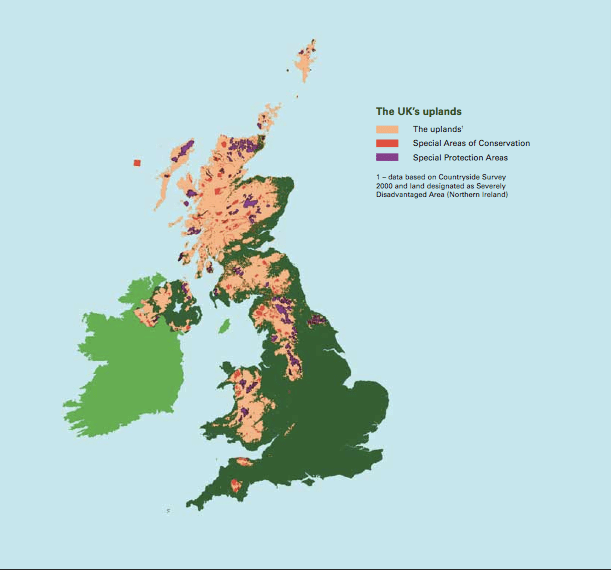
 

Source: RSPB

Source: RSPB

With habitats restored and the core areas linked together, wildlife which cannot naturally recolonize but play vital roles within the ecosystem can be reintroduced. Beavers to restore wetlands and peat bogs, lynx to control numbers of roe and muntjac deer, and wild boar, nature’s gardeners, to enrich the soil through their rooting, and allow diverse flora to grow rather than the bracken monocultures of today.
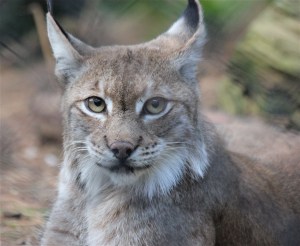
In the long-term, the option is then open for bigger fry as the habitat matures, the corridors are established and people have had time to live alongside such wildlands. Red deer are not likely to be effectively controlled by lynx. Time to call upon the wolf. With enough land cover, perhaps even moose can find a home here again, and the globally endangered European bison can have another safeguarded refuge on our shores.

So a network of rewilded uplands, all linked together, with missing habitats and megafauna restored. Should I ever manage to get the project off the ground in my career, I know I’d never live to see the completed goal. We’re talking decades, potentially centuries here. But before I can get dreaming, I imagine most who read this will think ‘nice idea, very impractical’. I’ll give them some credit for that; it’s only human to be cautious towards proposals that seem too good to be true (though there are many who would also describe these aspirations as far from ‘good’).

But this is going by our current line of conservation thinking, and as the biodiversity crisis has got no better, we’ve got to think crazy. E.O Wilson is respected as one of the soundest, foremost opinions on conservation biology – and he’s proposing this globally, let alone just in Britain!

We already know these areas are largely useless for their current ‘economic’ purpose of hill farming, else we wouldn’t shove in subsides from the taxpayer that keep them afloat. Despite this, losses are so poor that a lamb born following a bad winter can be worth less than £1, mental health issues in farmers like depression are rife, and many of their children are upping sticks to the lowlands rather than carrying on this ineffective practice. In terms of carbon storage, water treatment, forestry, (controlled) hunting and ecotourism, returning the uplands to nature is likely to be far more beneficial to the economy than scraping a few sheep out of a biological desert.

We can continue trying to rinse blood from a stone in the wasteland, or we can regrow the garden. I’m well aware of the path I’ve set for myself is challenging and isn’t exactly a modest life-plan. It’ll piss off a lot of people, however hard I may try not to, but equally I know there are so many out there who feel the same way, and would also want to work towards making this a reality. As any conservationist will tell you, you might as well give up if you don’t work as a team. It’s something where Wilson’s biophilia really needs to come to the fore too. These kind of plans would require mass broadcasting to the public at large – it should be a people’s project.

That’s my vision for nature – who else is in?

Flood Problems? Then it’s time for the return of nature’s master engineer.

Firstly, a quick apology for having been a bit silent within the blogsphere over the last few months. New articles stopped coming in pretty much the moment I started my first year at university, and the time between then and now has essentially been trying to make some structure out of the multitude of things going on, both within the course and commitments outside it. With a new year however normal service is beginning to resume, and my resolution is to try and update the blog, both here and on the Independent, as frequently as university life will allow – but even if it does get a bit slow, each new post will at least try to pack a punch!

With that out of the way, it’s on to the issue of the moment. The weather.

That stalwart of British conversation starters has moved beyond the realms of small-talk and into the throes of political and environmental debate over the last month. You’ve all seen the footage of flooded farmland on neo-biblical proportions, miserable people wading knee-deep through town centres and even more miserable journalists standing outside in the deluge with little more than an anorak that would be small on Paddington Bear (can’t they at least give them umbrellas?) Regardless, Britain’s been a lot wetter than it should normally be, and politicians have been searching for all sorts of excuses as to why, while the environmentalists know why and wonder why nothing was done about it.

If you’re talking about the heavy rain itself, well that’s just one of the extremes in weather science tells us to expect from climate change – but that’s another topic for an extremely long article. The major bugbear has been the extortionate levels of flooding, and most scientists and advisors with sense realise it’s due to the inadequate ways rivers and catchments are maintained upstream in rural areas. As it stands, our bare uplands lack the vegetation required to absorb rainwater rather than have it run-off, too many of our floodplains are drained, and many of our water courses are too rigidly canalised.

Issues like these have shifted from the media to debate in the commons thanks to George Monbiot (see ‘Drowning in money‘), yet despite promising talk of reforesting upland areas and encouraging river rewilding (from the mouth of Owen Paterson, the environment secretary failure extroadinaire no less), talk has shifted back down the sense scale faster than a flash flood in Somerset, with David Cameron encouraging dredging with open arms. Mere days after it was dismissed in parliament as both ecologically destructive, and very useful at causing floods downstream.

Continual draining and run-off from agriculture will continue to produce significant floods, yet many alleviation programmes, such as afforestation, don’t take place overnight (As travesties such as the badger cull have shown, patience doesn’t seem apparent in environment ministers). There is however one natural solution that once established, would have a swift effect and do it all for free.

I’m talking about bringing back beavers. And not surprisingly, other conservationists feel this is the perfect time to bring this issue back into the frame.

Perhaps not the most orthodox choice, and I can see why it’s taken so long to suggest this – suggestions about ‘x technological method of flood prevention for £x over x years’ sounds far more serious and directional than suggesting a mass-release of giant rodents. But as anyone who’s seen a beaver dam will attest, beavers create serious new wetlands that create huge catchments of water upstream. In these reservoirs, water is released slowly, and the rapid flow that creates floods in the towns below is negated.

European beaver, photo taken in England, but of a captive individual at the Wildwood Trust. How long before these kind of shots can be taken along the Thames or Itchen?

European beaver, photo taken in England, but of a captive individual at the Wildwood Trust. How long before these kind of shots can be taken along the Thames or Itchen?

I’ve always been strongly in favour with beaver reintroduction, but since my visit to ecologist Derek Gow’s farm in September, I feel it should be one of our priorities within UK nature conservation. Derek has a family of beavers on his farm left to themselves, and they’re largely there to prove to farmers that they aren’t apocalyptic beasts of destruction, but animals that we can easily live alongside, and even benefit from.

Yet as Derek told me, the beaver is a test of our bravery in conservation. We know what it does and the benefits it brings, yet because it has an influence in changing the structure of its environment, landowners will generally stamp down their feet and say no. If we can’t look beyond the occasional flooded pony field and take in the wider benefits beavers create in ecological restoration, flood defence and water purification, we will never achieve any more dramatic rewilding proposals. And quite frankly, if nature conservation here stays the way it currently is, it’s all a bit doomed.

So it seems that now is the time for that test. Let the government and our farmers see how easily even urban populations can live alongside beavers in Europe, and how effective their wetlands are at holding back all that water that would otherwise be spilling out into homes and drowning taxpayer’s money. We can’t afford to say ‘no’ now without any further thought.

Let’s make the first of many ‘crazy’ moves in conservation, and restore the beaver to our shores at a time when we need it most.

Buzzard-Gate: Where are DEFRA’s priorities?

Last week, completely out of the blue, DEFRA decided to announce their plans for buzzards, our most common, and certainly well loved, raptor. For some reason, they thought that just because they didn’t want to kill them meant it would go down OK. But in a government that consistently wants to brush aside that pesky, growth-intrusive thing called wildlife (Forest sell-off, Planning law changes, Badger cull, et al), suddenly going “hey, instead of preserving nature why don’t we go about trapping and destroying the nests of buzzards just so Lords & Toffs get a few more pheasants to blast out of the sky” was never going to be a popular move.

Starting with basics, is it that big a problem? Sure, if there’s hundreds of sitting, um, pheasant chicks sitting plump in a rearing pen the buzzard will have a go, and there’ll be losses. I live nextdoor to a fantastic piece of woodland that unfortunately is also used for pheasant rearing and shooting. But it also has a stable buzzard population with up to 5 individuals sometimes being present in the same area. And while you can sometimes see the remains of an unlucky pheasant that ended up as buzzard soufflé, there are still hundreds of the bloody things around by February, doomed to be blasted out mid-flight by wealthy hoo-rahs or wrung in the neck if the shot didn’t do the job.

The worst bit however is the dozens that survive the season. Reared by gamekeepers who plonk out seed for them as if they were farmyard hens, when they are released into the woods the struggle to adapt to a wild life takes out many. The more savvy ones however rip apart the woodland floor in numbers far beyond what nature would usually allow. The impact of so many of this non-native species on our woodlands would be a far more resourceful use of DEFRA’s time (but they’d be undoubtedly too scared to do it for fear of upsetting Dave, Ozzy and the rest of their gun-ho chums).

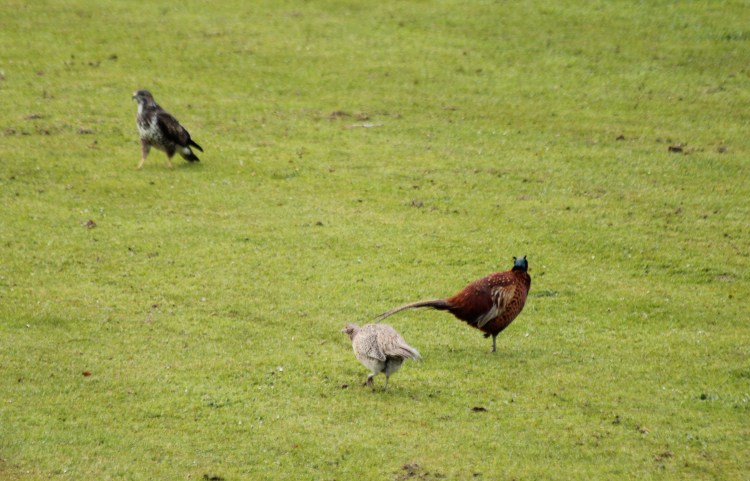
So why did DEFRA even consider this plan? If anything buzzards are absolutely beneficial to pheasant shooting, keeping their numbers down so there aren’t so many ‘surplus’ after the shooting toffs have put a mark on the amount they can either eat or stuff in a pit. And anyway, buzzards are more inclined to go scouting for carrion, swoop down on rabbits or pluck earthworms than bother pheasants most of the time. The buzzard in this picture (taken from my bedroom window) was far more interested in the former than eating the bystanders.

Once again, it is a sign of a government that doesn’t understand or care about nature at its core. Rather than spend money on making Marine Nature Reserves, increasing our wildflowers and pollinating insects, developing outdoor learning for schools or any number of beneficial ways of preserving our wildlife for both its own value and future generation’s, they try a stupid plan especially for the ‘elite’ of people who run our country. And as they’re not even considering netting over rearing pens, which would cost just as much or even less than the current plans, it shows predator-prejudice is once again the subconscious feelings at the heart of this. Buzzards join a long list that includes foxes, corvids and sparrowhawks, all species’ scapegoated to take the blame for many of the problems we’ve made.

But just as we stopped the forestry reforms, the public voice is the best way to stop these ridiculous ideas. Start by signing the petition, or even better contact DEFRA directly. We can’t let our supposed guardians of rural Britain prioritise some rich fat cat’s game over the far more valuable buzzards and the rest of our country’s wildlife.

Stripes v Spikes?

Today’s post concerns the interesting nuggets of thought to chew on that was raised by Micheal McCarthy in his most recent edition of ‘Nature Studies’ in the Independent, entitled ‘More badgers and fewer hedgehogs. Coincidence? I don’t think so’.  Before I go on, I’d just like to mention that Nature Studies is one of the best natural history columns out there, not surprising considering that McCarthy is a fantastic environmental journalist; I’ve only just started reading his book Say Goodbye to the Cuckoo, and already I would heartily recommend it to others just from the first chapters.

And like all good journalists, a topic that needs a longer than average musing should be brought up from time to time. In this case, it’s the suggestion that perhaps increasing badger populations across the UK are partly to blame for the hedgehog’s worryingly dramatic decline over the last 30 or so years. It could potentially be in the Chris ‘I’d happily eat the last panda’ Packham spectrum of controversies, and as McCarthy points out, with the first cull trials imminent (something I heartily disagree with based on the scientific evidence, but that’s another story) our monochrome mustelid friends don’t really need anymore cause for concern on their reputation. Continue reading